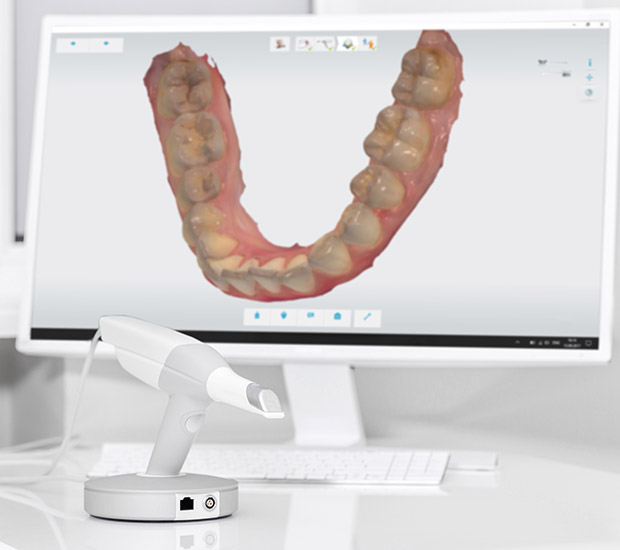
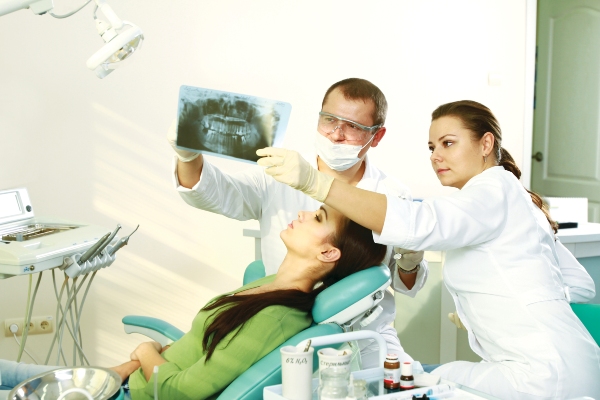
3D Cone Beam and Dental Scan utilizes technology to provide a quick, painless, and comprehensive look at the teeth and the surrounding dental structures. Many complete health dentists assess the structures of the mouth using a technology that goes beyond the traditional X-ray called Cone-Beam Computed Tomography (CBCT), also referred to as a "3D Cone Beam," "3D Dental Scan," or "Beam CT." Traditional X-rays only provide images of your dental structures from one plane, meaning that if your dentist needs to zero in on a particular area, you may have to have additional X-ray views taken.
This is where 3D cone beam technology comes in and offers a more efficient option. For more information about 3D dental scanners, our team at Vatan Dental Group in Los Angeles is here to help. Call us at (310) 906-1300 to learn more.
A 3D cone beam machine resembles conventional CT scan machines and comes in two different structures: an upright chair for sitting or a moveable table for lying down. Depending on the procedure and type of machine being used, the patient will be seated in an exam chair or lie down on an exam table. The chair has an extendable arm (C-arm) while the table has a rotator (gantry) that both rotate 360 degrees around the patient's head, taking multiple images at once.
The images are taken at different angles and gathered to create a single 3D image. According to the Radiology organization, "In a single rotation, the detector can generate anywhere between 150 to 200 high resolution two-dimensional (2-D) images, which are then digitally combined to form a 3-D image that can provide your dentist or oral surgeon with valuable information about your oral and craniofacial health." The 3D image is available as soon as the scan is complete, allowing the doctor to discuss the patient's treatment plan in the same visit.
“The chair has an extendable arm (C-arm) while the table has a rotator (gantry) that both rotate 360 degrees around the patient's head, taking multiple images at once.”
How Is 3D Dental Scanning Different From Traditional Imaging?
The 3D dental scanning technique differs from traditional imaging because it can collect hundreds of 2D images in a single scan and then aggregate these 2D images into a 3D reconstruction. This process is faster and more comprehensive than traditional imaging. The images are of much higher quality, and they can provide the complete health dentist with more information to aid in the detection, diagnosis, and treatment of oral conditions. Many patients find that 3D dental scanning is also less uncomfortable than traditional imaging because of its speed and because it does not require traditional bitewing sensors.
“Many patients find that 3D dental scanning is also less uncomfortable than traditional imaging because of its speed and because it does not require traditional bitewing sensors.”
What a Cone Beam Image Reveals
Cone beam CT scanners reveal far more information than traditional scanners and provide detailed images of a patient's underlying bone structure. Cone beams are primarily used for cases in which traditional X-rays would not provide sufficient information needed for treatments, specifically surgeries and underlying disease. They can evaluate diseases of the jaw, dentition, body structures of the face, nasal cavity, and sinuses.
Cone beam technology has also been useful for diagnosing oral cancers and cysts and managing impacted teeth. A study on cone beam technology found that there has been a "significant contribution of CBCT in the planning and successful surgical management of dentigerous cysts and associated impacted teeth." Since cone beams take wide range photos, they capture in-depth areas that traditional scanners can easily miss.
“They can evaluate diseases of the jaw, dentition, body structures of the face, nasal cavity, and sinuses.”
After a 3D dental scan, the complete health dentist will have a clear and concise three-dimensional image of the teeth, mouth, jaw, neck, ears, nose, and throat. The dentist will be able to immediately review this image and use features such as zooming and rotation to get the best possible view of any area in question. There is no recovery time after this procedure, and the patient will be able to immediately return to their daily activities.
“The dentist will be able to immediately review this image, and use features such as zooming and rotation to get the best possible view of any area in question.”
A.Not very long. A 3D dental scan comprises one rotation of a mechanical arm around your head. After you are positioned, the scan itself usually takes less than 30 seconds.
Q.How long have dentists been using 3D scanning technology?
A.According to the FDA, CBCT technology has been in use for twenty years. Dental scans are becoming more common every day because of their helpfulness in planning for procedures and diagnosing complex conditions.
Q.How much radiation does a 3D scan emit?
A.A 3D dental scanner is considered a computed tomography (CT) scan. Still, it emits less radiation than other conventional CT scans that are commonly used in medicine. However, a CBCT scan does emit more radiation than traditional dental x-rays.
Q.What do patients think of 3D cone beam scanning technology?
A.Patients are often impressed to see a three-dimensional image of their own maxillofacial region. When the dentist can show a patient how a procedure works on their actual mouth and jaw, it helps them have a deeper understanding of the work. Then, patients are more comfortable with the procedure and even have an easier time explaining to others how it works.
Q.What is a 3D cone beam scanner typically used for in dentistry?
Diagnosing temporomandibular joint disorder (TMJ)
Diagnosing the origin of oral pain and disease
Making a surgical plan for extracting impacted wisdom teeth
Planing dental reconstruction procedures
The planning and placement of dental implants
Quality Dental Services Can Transform Your Smile
By visiting us as soon as possible, our team can help get you the professional treatment you need. Instead of waiting around and allowing the symptoms to get worse, we can provide you with treatment options.
An anesthetic is a substance that reduces or removes sensation from the area of the body it is applied to.
Computerized Tomography (CT)
A computerized tomography scan compiles multiple X-ray images taken from different angles to create cross-sectional images of the internal anatomy.
Dental Cone Beam Computed Tomography (CBCT)
A dental cone beam computed tomography (CBCT) is a special type of X-ray equipment that reconstructs a 3D image of the patient's anatomy.
Dentist
A dentist, also known as a dental surgeon, is a doctor who specializes in the diagnosis, prevention, and treatment of diseases and conditions of the oral cavity.
Dentistry
Dentistry is the profession that deals with preventing and treating any diseases and aberrations of the teeth, gums, and oral cavity.
Dentition
Dentition refers to the way the teeth are arranged in the mouth.
Oral Surgery
Oral surgery is the branch of dentistry or surgery that repairs the mouth or jaws.
Radiation
Diagnostic radiation allows healthcare practitioners to see structures inside the body.
Radiography
The process of creating photographs produced by a form of radiation.
X-rays
X-rays are a form of electromagnetic radiation capable of penetrating solids and producing radiographs.
Learn More About 3D Scans Today
If you are looking for more information pertaining to complete health dentistry or the use of 3D cone beams or 3D dental scans, call us at (310) 906-1300.
We accept the following payment methods: American Express, Cash, Check, Discover, MasterCard, and Visa
We serve patients from the following counties: Los Angeles County
We serve patients from the following cities: Los Angeles, Inglewood, Westchester, Marina del Rey, Playa del Rey, Playa Vista, Culver City, Fox Hills, Hawthorne, El Segundo and Santa Monica
Getting dental implants is a major decision. It is an invasive procedure that places titanium rods in your jawbone. The healing time will take months, but the result will be worth the wait. Understanding the process will allow you to
Dental implants provide a long-term solution for missing teeth, offering functional and aesthetic benefits. Designed to mimic natural teeth, they help restore the ability to chew, speak, and smile with confidence. The process of receiving dental implants involves multiple stages,
Dental implants provide a long-term solution for those missing teeth, improving oral health and function. However, patients should learn as much as possible before the procedure to ensure the most effective treatment outcome. Asking the right questions during a consultation
Dental implants often beat out other tooth replacements due to their natural appearance and durability. Although getting them can be a lengthy process, many patients find it a worthwhile one. Proper preparation can contribute to a smooth experience and optimal
Not only does replacing missing teeth restore the smile’s appearance, but it also enhances oral health and helps preserve the jawbone. Dental implants are a reliable, durable solution for patients who require multiple tooth replacements, as they provide stability and